Source Eco Friendly Bamboo Dinner Plate for Catering, Events, and Retail
Compare 30 eco friendly bamboo dinner plate options from verified Chinese manufacturers. Evaluate customization, certifications, and packaging details to find the right sustainable tableware for your business needs. Assess material grades, moisture content, and surface treatments to ensure quality and compliance with your specific operational requirements.
Key considerations
Products List






Comprehensive Sourcing Guide
Eco Friendly Bamboo Dinner Plate Sourcing Guide
Procuring eco-friendly bamboo dinner plates requires distinguishing between disposable and reusable variants, as the supplied data reveals conflicting attributes where some listings specify "Disposable" while others indicate "Non-Disposable." Buyers must carefully review product descriptions to ensure the selected item aligns with their specific operational needs, whether for single-use events or long-term hospitality service. The material composition is consistently identified as Bamboo & Wood, often treated with food-safe oils like Food Oil or Foot Oil to enhance durability and moisture resistance.
The observed market signals indicate a wide range of customization options, with many suppliers offering designs based on client requirements and the ability to apply logos through burning or engraving. However, the presence of both "Customized" and "Non-Customized" statuses in the data suggests that standard inventory may differ significantly from bespoke orders. Sourcing teams should verify if the specific model, such as the Environmental Dinner Plate-080e-024r-080A, supports the desired level of personalization before committing to a bulk order, as this directly impacts production timelines and unit costs.
Product Scope and Observed Listing Signals
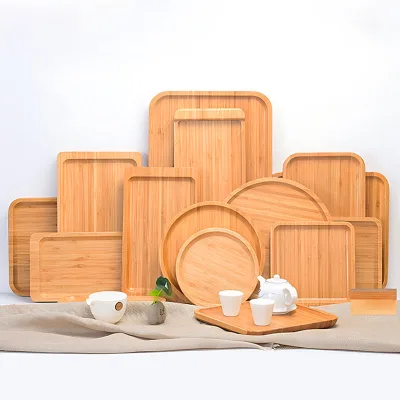
The product scope encompasses a diverse array of shapes and dimensions, ranging from round plates measuring 13 to 30 centimeters to square and rectangular formats with specific thicknesses. Listings show sizes like 20x20x2cm and 30x30x2cm, alongside palm leaf alternatives labeled as "Copostable Plam Leaf Plates," indicating a broader category of plant-based tableware. Buyers should note that while the core material is bamboo, the inclusion of palm leaf options suggests a need to clarify the exact botanical source to meet specific sustainability claims or customer expectations.
Commercial signals reveal a significant variation in minimum order quantities, with observed ranges spanning from 50 to 5000 units, and specific listings citing an MOQ of 2000 pieces. Pricing data observed in the market falls between 0 and 8 USD, though this wide range likely reflects differences in size, finish, and customization levels rather than a uniform price point. Procurement strategies must account for these fluctuations by requesting detailed quotes that specify the exact model number and packaging configuration, such as polybag or carton packing, to avoid unexpected cost escalations.
Technical Specifications to Verify
Technical verification must begin with moisture content, as the data lists values of 12% and a range of 10-12%, which are critical for preventing warping and ensuring structural integrity during storage and use. Buyers should explicitly confirm the moisture level for their specific batch, as deviations can lead to product failure in humid environments. Additionally, the surface finish is described as "Well Sanding," a process that affects the tactile experience and safety of the plate edges, requiring physical inspection to ensure smoothness and the absence of splinters.
The application of lacquer is another critical specification, with observed treatments including Food Oil, Foot Oil, and Food Lil, which serve different protective functions. It is essential to distinguish between these finishes, as "Foot Oil" may imply a different chemical composition or application method compared to food-grade oils, potentially affecting safety compliance. Furthermore, the standard dimensions vary by model, with some plates specified as 20cm diameter and others as 30x30cm, necessitating precise measurement verification against the supplier's technical drawings to ensure compatibility with existing table settings.
Compliance and Safety Documentation
Compliance verification is paramount, as the supplied facts list certifications including CE/EU, FDA, and CIQ, which indicate adherence to various international safety and quality standards. Buyers must request valid, up-to-date certificates for each specific product model to confirm that the bamboo and wood materials have been tested for food contact safety. The presence of multiple certification types suggests that different suppliers or product lines may hold different credentials, requiring a line-by-line audit to ensure the entire order meets the regulatory requirements of the destination market.
Safety documentation should also address the specific treatments applied to the bamboo, such as the use of food-grade lacquers and oils. While the data mentions "Food Oil" and "Food Lil," the term "Foot Oil" raises questions about its suitability for direct food contact, necessitating a clear declaration from the supplier regarding the chemical composition of all surface treatments. Procurement teams should demand Material Safety Data Sheets (MSDS) for any coatings used to verify that no harmful substances migrate into food, ensuring the final product remains safe for consumer use.
Cost Drivers and Commercial Terms
Cost drivers in this category are heavily influenced by the level of customization, with options for custom logos and designs adding significant value but also increasing production complexity. The data indicates that OEM is accepted and customization is available, which allows for branding but requires careful negotiation of unit prices based on the volume of the order. Buyers should anticipate that smaller batches, potentially as low as 50 units, may carry a higher per-unit cost compared to larger orders that can leverage economies of scale, as suggested by the observed MOQ range.
Commercial terms must clearly define the packaging specifications, as the data shows variations between polybag packing and carton packing, with some listings specifying 25 pieces per bag. These packaging choices directly impact shipping costs and the efficiency of logistics, particularly when calculating the single gross weight of 0.700 kg per item. Procurement agreements should explicitly state the packing method to prevent discrepancies in freight charges and ensure that the goods arrive in a condition suitable for retail display or immediate use without additional repacking.
Supplier Qualification and Quality Control
Supplier qualification requires a thorough assessment of their manufacturing capabilities, particularly regarding the origin of materials and the consistency of their production processes. The data points to origins in Hunan and Guangdong, China, regions known for bamboo processing, but buyers should verify the specific factory location to ensure transparency and traceability. Quality control protocols must be established to monitor the "Well Sanding" process and the application of lacquers, ensuring that every plate meets the specified moisture content and dimensional standards before shipment.
Quality assurance should also include a rigorous inspection of the logo application, whether through burning or engraving, to ensure consistency and clarity across the batch. Since the data lists both "Custom Logo" and "Burning" as features, buyers must provide clear artwork specifications and approve a pre-production sample to verify the quality of the branding. Implementing a third-party inspection service for the final random sampling of the order can help mitigate risks associated with inconsistent finishes or packaging errors, ensuring that the delivered goods match the agreed-upon specifications.
Long-Term Procurement Checks
Long-term procurement success depends on establishing a reliable supply chain that can consistently deliver products meeting the evolving standards of eco-friendly tableware. Buyers should conduct periodic audits of their suppliers to verify that the certifications, such as FDA and CE/EU, remain valid and that the production processes have not drifted from the agreed-upon quality benchmarks. Maintaining a relationship with suppliers who offer flexible customization options will allow buyers to adapt their product lines to market trends without disrupting their supply chain.
Continuous monitoring of market trends and material availability is essential, as the bamboo industry is subject to seasonal variations and regulatory changes. Buyers should stay informed about updates to food safety standards and sustainability certifications to ensure their products remain compliant and competitive. By regularly reviewing the performance of their suppliers against key metrics like lead times, defect rates, and packaging integrity, procurement teams can proactively address potential issues and maintain a high standard of product quality over the long term.
FAQs
What certifications are available for eco friendly bamboo dinner plates?
Available certifications include CE/EU, FDA, and CIQ. These ensure compliance with international safety and quality standards. Buyers can verify specific documentation from suppliers to confirm regulatory adherence for their target markets.
Can eco friendly bamboo dinner plates be customized with a logo?
Yes, customization is available for logos. Options include burning or engraving techniques to apply custom branding. This allows businesses to maintain brand identity while using sustainable tableware solutions for their events or retail products.
What is the typical moisture content for bamboo dinner plates?
The moisture content typically ranges from 10% to 12%. This level ensures durability and prevents warping during storage or use. Maintaining this standard helps preserve the structural integrity of the bamboo material throughout the supply chain.
Which sizes are offered for eco friendly bamboo dinner plates?
Sizes include round and square options ranging from 13cm to 30cm. Specific models feature dimensions like 20x20cm or 30x30cm. Buyers can select dimensions based on serving requirements, with some suppliers offering custom sizing as needed.
How are eco friendly bamboo dinner plates packaged for shipping?
Packaging options include individual polybags or bulk cartons. Some products use lamination packs for protection. Carton specifications vary, such as 25 pieces per bag, ensuring safe transport and efficient handling for international logistics and warehouse storage.
What is the minimum order quantity for bamboo dinner plates?
MOQs range from 50 to 5000 pieces depending on the supplier. Some specific models require a minimum of 2000 pieces. Buyers should confirm exact MOQs with manufacturers to align with their inventory needs and budget constraints effectively.